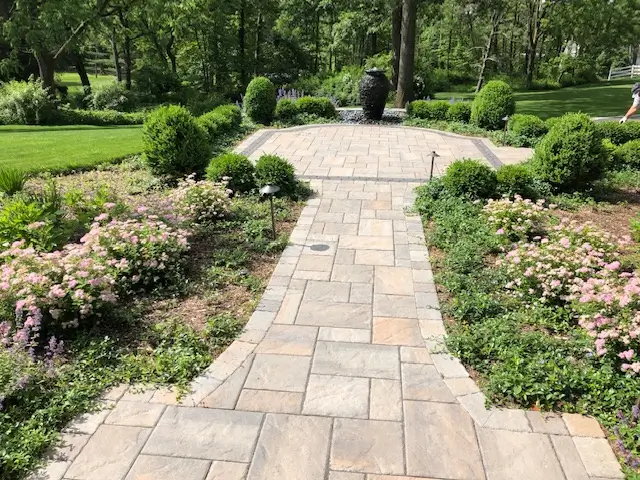
The right landscape contractor near you designs an outdoor space around how you live, builds it on a base that holds up to New Jersey winters, and stands behind the work when something shifts. In Northern NJ, the base matters most. Freeze-thaw cycles and dense clay soil test every patio, walkway, and wall.
Most people who type “landscape contractor near me” into Google already have a photo of a patio they love. The finished surface is the easy part to judge. What sits underneath decides whether that patio still looks right in five years or starts to dip by the back door after the second winter.
Fox Hollow Landscape & Design has built and repaired outdoor spaces across Northern NJ for more than 35 years, in towns like Boonton, Mountain Lakes, Denville, Morristown, and Chatham. This guide walks through what a professional landscape contractor near you handles, where shortcuts tend to show up, and what to check before you sign anything.
What does a landscape contractor do?
A landscape contractor plans, builds, and repairs the permanent parts of your outdoor space. At Fox Hollow, that work falls into a few connected areas:
- Landscape design that lays out patios, planting beds, walkways, and lighting around how you use the yard.
- Hardscaping, including stone and paver patios, walkways, retaining walls, and decorative stonework.
- Paver repair for surfaces that have cracked, settled, or shifted out of level.
- Irrigation that keeps new plantings and lawns healthy through dry NJ summers.
Explore all of our services here.
The design and the build should come from the same team. When a designer draws a patio without knowing what the soil, slope, and drainage look like on your lot, the installer ends up solving problems the plan created.
What shapes the cost of a paver patio?
Cost is the first question most homeowners ask a landscape contractor, and two patios that look identical in photos can be priced very differently. Most of that gap comes from work you won’t see once the job is done.
The biggest factors include:
- Excavation and base. A patio built to last needs enough depth for a compacted gravel base, and clay soil often calls for a fabric layer between soil and stone. The Interlocking Concrete Pavement Institute’s construction guidelines recommend that separation layer over clay subgrades and in freeze-thaw climates, which describes most of Morris County.
- Grading and drainage. Water has to move away from your foundation. On a sloped lot in Montville or Denville, that can mean added steps, a low wall, or a drain line.
- Material. Concrete pavers, natural bluestone, and poured concrete each wear differently and cost differently to install.
- Site access. A narrow side yard means more hand work and smaller machines.
- Design details. Curves, borders, sitting walls, fire features, and lighting all add labor.
When bids vary widely, compare base depth and drainage plans line by line. That comparison usually explains the price difference.
Why do DIY patios sink after a New Jersey winter?
Thousands of homeowners search for paver installation tutorials every month, and the videos make it look manageable. The trouble starts below the surface. Most DIY patios fail because the base is too thin, the soil underneath wasn’t compacted in layers, or the patio has no solid edge restraint holding the pavers in place.
Northern NJ makes those shortcuts show up fast. Water seeps into the base, freezes, expands, and lifts the pavers. When it thaws, everything settles back down a little unevenly. After a few cycles, you get dips where water pools, edges that spread into the lawn, and a trip hazard at the back door.
A professional landscape contractor compacts the base in lifts, checks the pitch so water runs off, and locks the edges before a single paver goes down. The finished patio looks the same as a DIY job on day one. The difference shows up in March. [INTERNAL: Patio Builders service page, anchor “paver patio installation”]
Should you repair or replace cracked and uneven pavers?
Most paver problems can be repaired without tearing out the whole patio. That’s one of the best features of interlocking pavers. A crew can lift the affected section, fix what’s wrong underneath, and reset the same pavers so the repair blends in.
The signs point to different causes:
- Sinking or dips usually mean the base settled or washed out in one spot, often near a downspout.
- Cracked pavers can come from heavy loads, freeze damage, or a void forming underneath.
- Weeds, moss, and white haze point to worn joint sand, standing water, or shade. The white haze is efflorescence, a mineral residue that cleans off and often fades on its own.
Replacement makes sense when settling covers most of the surface, the original base was never built right, or you want a new layout. An assessment from an experienced landscape contractor near you tells you which situation you’re in before you spend anything.
Why do retaining walls lean or bulge?
When a retaining wall starts to lean, the cause is usually water trapped behind it. Wet soil gets heavy, and in winter it freezes and pushes outward. A wall without clean gravel backfill and a drain pipe at its base takes that pressure season after season until the blocks shift.
That’s why retaining wall drainage draws steady search traffic year-round. Hilly properties in Boonton, Mountain Lakes, and Morris Township lean on these walls to create flat space for patios and gardens, so a failing wall puts everything above it at risk.
A well-built wall sits on a compacted footing, has drainage stone behind every course, and gives water a clear path out. Walls over a certain height may also need engineering and a town permit. A local landscape contractor will know what your municipality requires. [INTERNAL: Hardscaping service page, anchor “retaining walls and hardscaping”]
How do you vet a landscape contractor near you?
A search for “landscape contractor near me” returns a long list. These checks narrow it down quickly:
- Confirm state registration. New Jersey requires anyone who solicits or performs home improvement work to register with the Division of Consumer Affairs, which also lets you check for consumer complaints.
- Ask about the base. Have each contractor explain the depth, materials, and drainage plan in writing. Vague answers here are a warning sign.
- See local work. Ask for projects in your area, ideally a few years old, so you can see how they held up through real winters.
- Check who does the work. Find out whether the company’s own crew builds the project or subcontracts it out, and who you’ll talk to while it’s underway.
- Get the warranty in writing. Know what’s covered and for how long.
Experience counts in this trade because mistakes take a few winters to surface. A company that has worked in the same towns for decades has already seen how its own projects age.
Work with a Northern NJ landscape contractor who builds for the long haul
Fox Hollow Landscape & Design has spent more than 35 years designing and building outdoor spaces for homeowners in Boonton, Mountain Lakes, Denville, Parsippany, Morris Plains, Morristown, Montville, Chatham, Madison, and Morris Township. Our team handles the full project, from the first design sketch to the last paver, and we build every base for the winters it has to survive.
If you’re planning a new patio, need paver repair, or have a wall that’s starting to lean, we’ll walk your property, explain what we see, and give you a clear plan.
Request a free consultation
Frequently asked questions
What’s the difference between a landscaper and a landscape contractor? A landscaper typically handles ongoing care like mowing and planting. A landscape contractor designs and builds permanent features such as patios, walkways, retaining walls, and irrigation systems.
When is the best time to build a patio in Northern NJ? Spring through late fall works well, as long as the ground isn’t frozen. Booking a design consultation over the winter puts you ahead of the spring rush.
Can sunken pavers be fixed without replacing the whole patio? In most cases, yes. The crew lifts the settled section, rebuilds the base underneath, and resets the original pavers.
How do I get rid of moss on pavers and weeds between pavers? Clean the joints, then refill them with polymeric sand to block new growth. If moss keeps coming back, check for shade or standing water in that area.