Do I Need a Retaining Wall in New Jersey? How to Tell If Your Sloped Yard Is a Problem
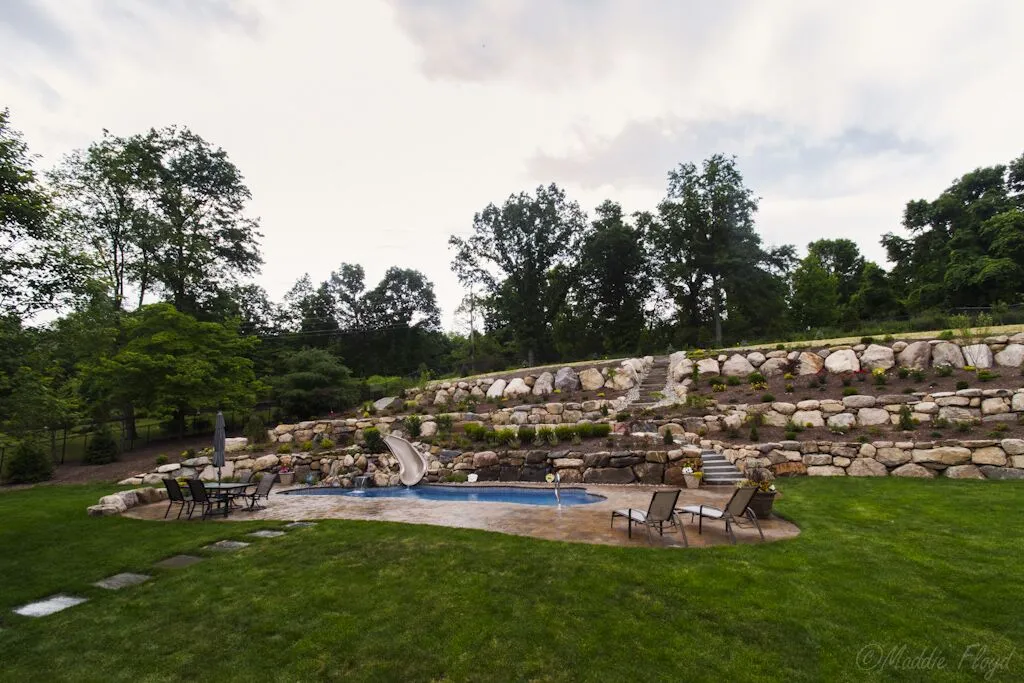
If you walk your property after a heavy rain, and you’ll get a good sense of how it’s doing. Maybe mulch collects in the driveway, or a corner of the lawn stays soft for a few extra days, or a section near the foundation has settled a little lower than it used to be. The great news is that every one of these is fixable, and often the fix ends up making the yard more beautiful and more useful than it was before.
Sloped property is common across Northern New Jersey, and it’s honestly one of the things that gives this area so much character. Morris County has rolling hills and valleys, so flat terrain is not in the equation. The fun part is figuring out how to make that slope work for you, and a well-designed retaining wall in New Jersey is often exactly the upgrade that unlocks it.
A slight grade in your lawn is completely normal, and it’s often intentional, since it helps water move away from the house the way it should. A few specific signs simply let you know it’s time to give that slope a little extra support, and they’re easy to spot once you know what to look for.
Soil erosion after rain. If you’re noticing bare patches where grass used to grow, or small channels in the dirt after a storm, that’s your yard telling you it’s ready for a helping hand. It’s actually one of the clearest, most solvable signs that a retaining wall in New Jersey properties like yours would benefit from, and the payoff is a yard that holds its shape through every season.
Water pooling near the foundation. Hydrostatic pressure builds fast when water has nowhere to go but toward the house, and homeowners in Denville and Parsippany see this fairly often after spring thaw. The good news is that a well-placed retaining wall solves this cleanly, guiding that water exactly where it should go instead of toward your basement.
Cracked or sinking patios and walkways. Soil that shifts under a slope settles unevenly, and the pavers or concrete on top of it settle right along with it. If you’ve had a spot repaired more than once, that’s genuinely good news: it means the real cause is easy to identify, and fixing the slope underneath solves the problem for good instead of patching it again next year.
A shrinking usable yard. Steep grades can quietly take up space that would otherwise be perfect for a patio, garden, or play area, and that’s one of the most rewarding fixes there is. A retaining wall levels out that section of yard and hands it right back to you, ready to enjoy.
New Jersey soil isn’t uniform, and that’s actually a wonderful thing, because it means the right solution is very knowable once someone takes a look at your specific property. Clay-heavy soil, common throughout Morris County, drains slowly and holds water against retaining structures longer than sandy soil does. Rocky terrain, also common here, can send runoff down a slightly different path with every storm depending on which section of bedrock it hits.
That’s exactly why a thoughtfully built wall performs so much better than a generic, big-box retaining wall kit. A retaining wall in New Jersey that accounts for local frost depth, proper drainage behind the wall, and the property’s specific soil composition will hold strong and look great for decades.
Towns like Mountain Lakes, Morris Plains, and Chatham are full of properties where a little extra planning up front made all the difference. Homeowners who invest in getting the design right the first time end up with a wall that just keeps performing beautifully, season after season.
A retaining wall is one of those upgrades that quietly does a lot of good at once. It holds soil in place on a slope, keeping erosion from ever getting started. It manages water, guiding runoff exactly where it’s supposed to go. And it creates brand new usable space, turning a hillside into a flat, welcoming area for a patio, garden bed, or outdoor living setup.
Materials play a big role in how well a wall performs. Natural stone, segmental block, and boulder walls each bring their own strengths depending on wall height, soil type, and water pressure, and choosing the right one from the start means enjoying the results for a long time to come, without ever needing to revisit the project.
Fox Hollow Landscape & Design has spent over 35 years getting to know the soil, slopes, and drainage patterns that make Northern New Jersey properties so unique, and that experience is what turns a tricky slope into one of the best parts of a yard. Every retaining wall project starts with a friendly, on-site evaluation of the grade, soil type, and water flow, tailored to that specific property rather than a one-size-fits-all template.
Homeowners in Boonton, Montville, Madison, Morris Township, and Morristown have partnered with Fox Hollow to transform problem slopes into finished, functional spaces they genuinely love spending time in.
If your yard is showing any of the signs above, there’s a lot to look forward to. Request a free consultation and the Fox Hollow team will walk the property with you and share exactly what’s
How much does a retaining wall cost in New Jersey? Cost depends on wall height, material, length, and drainage requirements, and every property brings its own possibilities. Fox Hollow provides a specific estimate after an on-site evaluation so you get an accurate picture, not just a general range.
Do I need a permit for a retaining wall in New Jersey? Many Northern NJ towns require a permit for walls over a certain height, often around four feet. Requirements vary by municipality, and a good contractor can help you sort that out quickly.
Can a retaining wall fix a drainage problem? Absolutely, as long as it’s built with proper drainage planned in behind it. That planning is what makes the difference between a wall that manages water beautifully and one that doesn’t.
How long does a retaining wall last? A properly engineered wall, built for New Jersey’s soil and frost conditions, can easily last several decades, giving you a long-term feature you never have to think twice about.
What’s the difference between a retaining wall and a regular garden wall? A retaining wall is structural, designed to hold back soil and manage water pressure on a slope. A garden wall is decorative. Knowing which one your yard needs is the first step toward the right solution.